


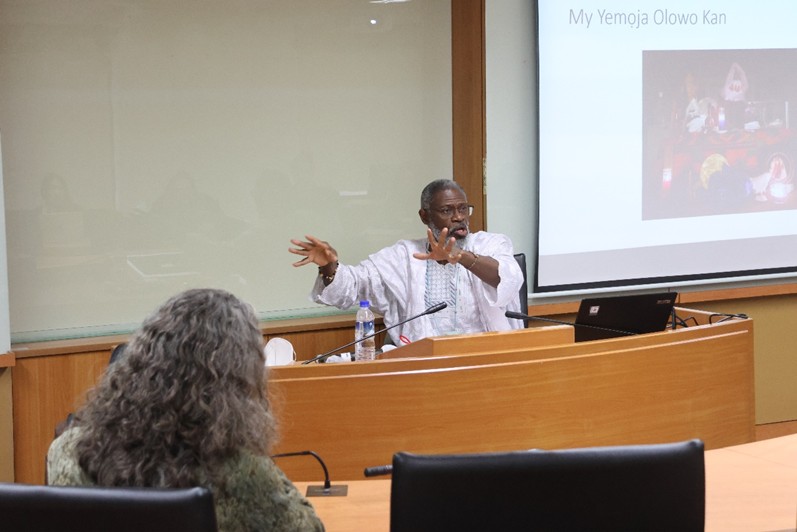
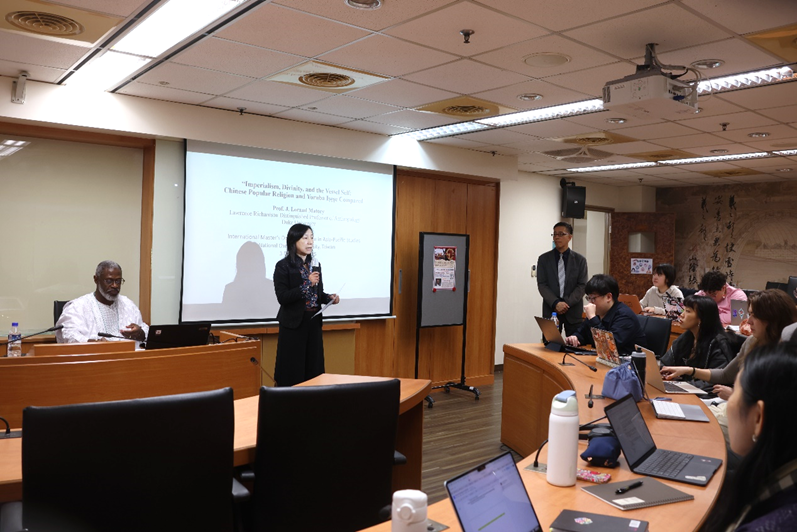
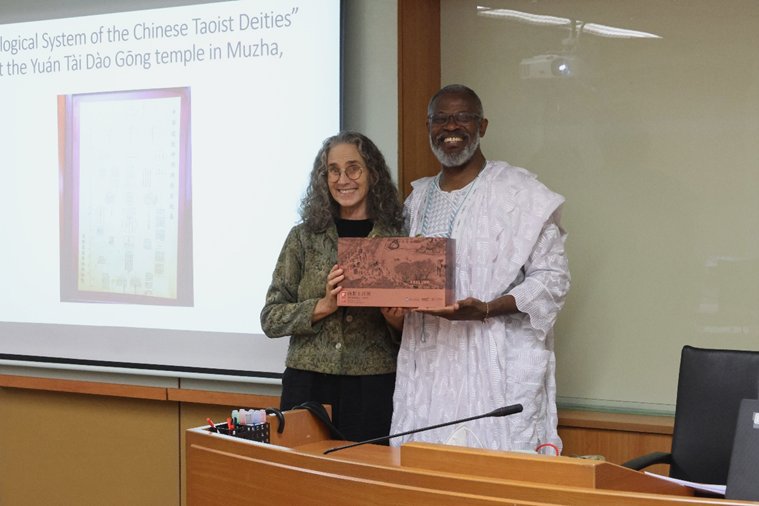
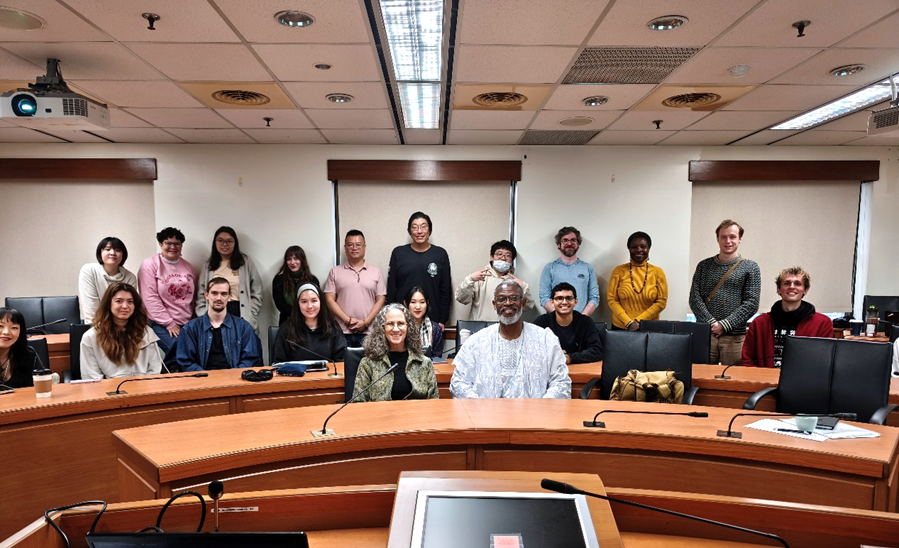
On December 3, the International Master's Program in Asia-Pacific Studies (IMAS) invited Distinguished Visiting Professor James Lorand Matory (馬杰明) from Duke University to give an in-depth comparative lecture titled “Divinity, Empire, and Diaspora: China and Africa Compared,” where he talked about religious hierarchies, imperial ideology, and popular religion in the Yoruba Atlantic world and in Chinese/Taiwanese spirit-possession traditions. The event was moderated by Associate Prof. Courtney Work from the Department of Ethnology.
Also present was Dean Wan-Ying Yang, who, in her opening remarks, expressed gratitude to Prof. Matory for his role in IMAS during the Fall 2025 semester. Prof. Matory co-taught the course “China, Africa, and Their Diasporas: Connections and Misconceptions” with IMAS Director Prof. Liu Hsiaopong. Prof. Matory is Lawrence Richardson Distinguished Professor of Cultural Anthropology and Director of the Sacred Arts of the Black Atlantic Project at Duke University. He has conducted more than four decades of research on African and African American Studies, especially across the Black Atlantic—Africa and the Americas. He has authored four books, over fifty articles, and produced or written five documentary films. Previously served on the Cultural Property Advisory Committee of the U.S. Department of State as well as the James P. Marsh Professor at Large at the University of Vermont, he received the Distinguished Africanist Award from the American Anthropological Association and the Alexander von Humboldt Prize from the German government.
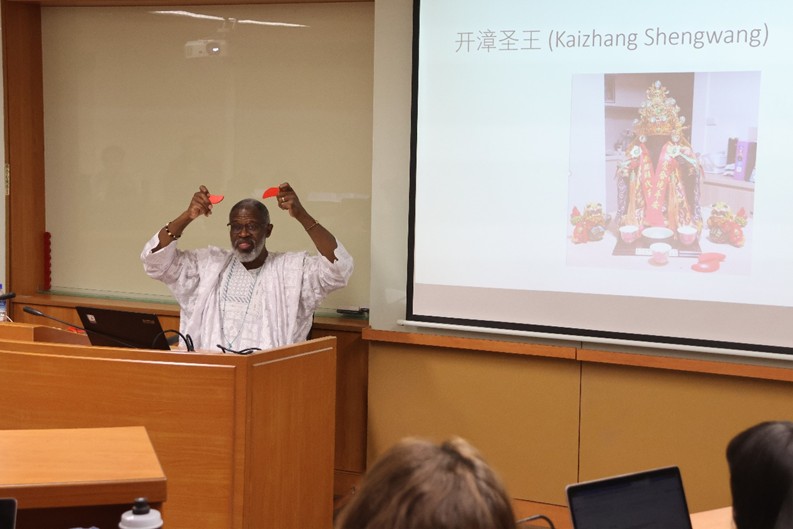
In this lecture, Prof. Matory compared Yoruba and Afro-Atlantic religions with Chinese popular religion, arguing that both operate through parallel logics of spirit genealogy, imperial delegation, and ritualized hierarchy. Sacred authority is transmitted from senior to junior temples—through Aṣẹ in African traditions, often via sacrificial blood, and through fénxiāng (分香) in Chinese temples, via incense ash. He illustrated this through two deities he personally worships: Yemọjá, a Yoruba river–ocean mother goddess, and Kaizhang Shengwang (開漳聖王), a Tang-dynasty general revered in Taiwan as a protector of settlers. In both traditions, divine order is modeled on imperial authority rather than democratic consensus: gods wield weapons, enforce discipline, and offer protection, while myths of their failure and revival reflect the emotional logic of sovereignty and empire.
Prof. Matory further argued that empire has historically been understood—by both bureaucrats and believers—not as a moral or rule-bound system, but as a form of violent realpolitik structured through unequal obligations and a tripartite order of elites, commoners, and colonized peoples. These religious imaginaries persist into the present, where many practitioners, even in democratic societies, express nostalgia for strongman authority, finding emotional comfort in imperial hierarchies amid the anxieties of personal freedom, self-responsibility, and modern neoliberal life.
Turning to Taiwan, Prof. Matory observed that Chinese popular religion thrives in a democratic society that overwhelmingly rejects political subordination to the People’s Republic of China (PRC). He suggested that devotees’ deep genealogical ties to Chinese deities—maintained through fénxiāng pilgrimages—may produce complex or ambivalent attitudes toward democracy, autonomy, and the PRC’s religious-tourism outreach. He emphasized that his argument is not a criticism but an analytic puzzle: why do people in successful democracies still imagine ideal power through imperial metaphors rather than through democratic ones? Why do devotees seek perfected monarchs in heaven rather than perfected democratic citizens on earth?
The lecture concluded with audience questions about god selection, African parallels to divine failure, memories of Taiping and Boxer Rebellions, diaspora identity, PRC’s United Front influence, and the secular analogues of ritualized hierarchy. Prof. Matory reiterated that gods, like political heroes, embody flawed yet idealized authority; that diaspora identities can be flexible and productive rather than essentializing; and that modern societies still seek ritualized hierarchies—religious or secular—to manage anxiety, belonging, and the desire for ordered meaning.
